It’s Cold Outside
Winter storms, ICE, and generating warmth

A decade ago, I was invited to tour the Karnes County Immigration Processing Center—an immigrant detention facility.
This facility was originally built to detain men and was operated by a private, for-profit prison group. In 2014, the center was converted to a family immigrant detention center.
The conversion, headlines explained, aimed to make the facility feel less prison-like. There were now basketball courts and a library.
The state was attempting to have the operation qualify as a licensed childcare facility (despite not meeting state childcare standards). I suspect that was, at least in part, why we—a small group of pediatricians and immigrant-rights lawyers—were allowed in.
In the days leading up to the visit I had to sign a Stakeholder Visitor Code of Conduct. The code of conduct, the form explained, “was to ensure security and avoid any disruptions in daily operations.” It outlined a long list of things I would and would not do. Essentially, I would be obedient. I would not incite violence. Electronic recording or communication devices of any kind were strictly forbidden.
Next I had to provide copies of my identification and send in my Social Security number for a background check.
I attended a briefing by the lawyers who had arranged the visit where they explained the legal landscape. They explained that the families inside were seeking asylum. There was no legal reason they should be contained in this way.
The day before the visit, I received notification that my background check had been approved. “Thanks! ICE has everything they need!” The email chirped.
We were told to arrive no later than 9 a.m. in order to complete the check-in and standard search of our “physical person and belongings” prior to our tour.
I left home shortly after 6 a.m. to be sure I had plenty of time for the 100-mile drive south.
As I drove, I could not help but think of all of the times I had driven through Karnes County before.
The detention center sits less than half a mile away from Highway 181, the road my family and I drove every summer of my childhood on our way to the beach. The flat land spotted with huisache and mesquite had always signaled we were getting closer to the ocean. It spurred a familiar rush of excitement. A feeling wholly incongruent with my agenda for the day.
Misalignment, I’d soon realize, would be the theme of the whole experience.
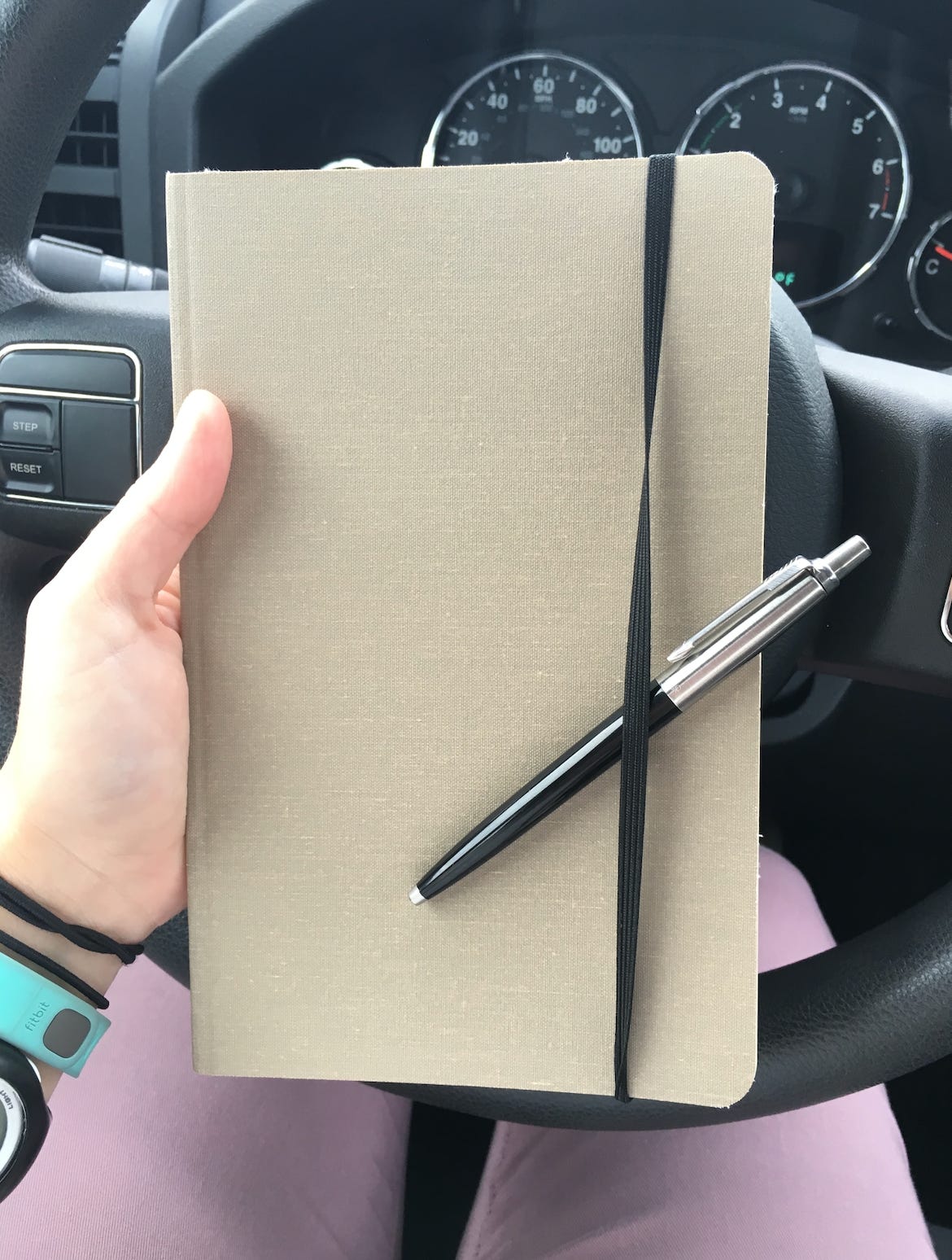
I pulled in to the dusty parking lot just before 9 a.m. I gathered the notebook and pen I had brought, and snapped a photo with the notebook propped against the steering wheel. I felt the urge to document something, but I didn’t yet know what I was trying to prove.
At check-in we were told to surrender all of our personal belongings, including our pens and notebooks. The lawyers pushed back. There was nothing in the code of conduct that said we could not take notes.
Eventually, the guards relented and let us keep our paper. Our cell phones were taken and locked away.
The guard opened a heavy door and ushered us into a small chamber with a second metal door opposite from the one we had just stepped through. We were in a “sallyport.” The same controlled entrance and exit system I recognized from my time taking care of prisoners in medical school. The first door clanged shut heavily, locking us inside.
We stood awkwardly locked in this chamber as the guard inched around us to unlock the second door, opening up into the facility at last.
It was 2015. I was early in my career. I knew it was a big deal to be invited inside one of the controversial facilities. But I did not really know what to expect.
I was not prepared for what was behind that second door.
Not because it was gruesome or violent—it wasn’t. At that moment, anyway.
Instead, it was disturbing because of the misalignment.
The contrast between the story we tell about this country and the reality behind that door.
What I saw was children—infants and toddlers, preschoolers, third graders, hundreds of them—in prison.
Because it turns out, even when you change the name of a building and add a library–– You are still putting children in cages.
There was no justification.
There never will be.
Misalignment
This week, the photos of terrified five-year-old Liam Ramos—taken after he was detained by ICE in Minnesota—transported me back to that facility.
News reports say ICE transported Liam to South Texas as well. I read he is currently detained at the Dilley Detention Center, a thousand miles away from his mother, but only two hours east of the repurposed prison that I visited.
I pulled up the emails from before and after my visit in 2015.
I read the long jagged essays that I wrote—but never shared—an attempt to process what I had seen and heard inside that building that day.
The words were too raw. They bled on the page.
A decade later they still do.
***
“Where do we even begin?” I wondered as I watched videos of Renee Good. A mom murdered in her car with stuffed animals in the glove box— documented from every angle. Her son is six.
“It looks so cold there.” I think, as I watch the videos of protest and terror on the streets of Minnesota that have followed.
“Have we lost our minds?” I question while watching videos of a group of men murder an ICU nurse in the snow of those same streets.
***
During our tour in Karnes, we asked if we could speak with detainees. We were swiftly told no. This would not be an option.
We persisted in our request. “Just for a few minutes” we pleaded.
We explained that talking with even a few detainees would help us understand the experience.
Eventually, after consulting with someone with more authority, our tour guide reluctantly obliged. We could meet for thirty minutes with a small group of hand-selected women after our tour.
We thanked her profusely.
Together with the women, we sat in a circle and explained who we were.
The tears began flowing before the words left their lips.
They described being shoved into a cold room with dozens of other women after having their children ripped from their arms. Inside these rooms, they waited for days. The room contained single bench and an open toilet. The lights never turned off. The women were so scared.
These rooms—hieleras, they all called them—the Spanish word for freezer, they explained, were so cold.
I thought I would never again see my baby.
***
I drove home in silence. The words of the women haunted my thoughts.
There seemed like so little I could do.
The next day, one of the immigration advocates that had helped arrange the visit, sent an email. In it, she thanked us all for making the trip.
“I know that it meant so much to the women and children you spoke with to know that individuals are concerned with their welfare.”
From the comfort of my warm home, it seemed ridiculous to be thanked for this.
But sometimes, showing that we care is what we have to offer.
And it matters.
***
A few months ago I attended a community event aimed to help people understand what we can do for our immigrant neighbors during this frightening time.
One of the speakers, an Imam from a local mosque, told a story about his father.
He explained that his father lived next door to an immigrant family. The neighbor had lost his job and the family was struggling.
The neighbor asked if his father had any work he needed done around the house.
Despite being someone who was staunchly opposed to hiring someone to do work he could do on his own, his father hired the man. As shocking as that was, the Imam explained, he was even more surprised by how much his father paid for the neighbor’s services.
“My father is cheap!” he shouted as the audience laughed.
He went on to explain that this is how we show up for our community.
By asking what our neighbors need. In this case, work. And then finding all of the small ways we can help meet that need.
The story has stuck with me. And I’ve been looking for ways to show up this week.
I decided it was time to find homes for the baby shoes my toddler has outgrown. The huge box of diapers we no longer need.
I called my friend from Honduras. Do you know anyone that could use these shoes?
“Of course!” she told me. “Whatever you have, I know someone who needs it.”
I gave her the shoes.
I took the diapers to Casa Marianella, one of the few shelters in the country that welcomes displaced immigrant and asylum-seeking families, many of them directly from detention centers.
This won’t stop ICE, but at least they know someone cares.
***
After my visit to Karnes in 2015, people kept pushing. Quietly and loudly, locally and nationally. Lawsuits. Reporting. Organizing. Pressure.
By 2021, the practice of family detention had nearly stopped. The centers in Texas were no longer detaining children.
In March of 2025, it began again.
***
It’s easy to blame a handful of people in power for the horrific things happening nationally.
It’s harder to recognize the ways that we handed them that power.
We can take it back though. Piece by piece.
***
Action we can take
The Department of Homeland Security appropriations bill is moving through Congress right now. There is enormous pressure to pass it, because if nothing is approved by January 30, the government will shut down.
But the current draft includes $10 billion for ICE—with no meaningful guardrails.
No body camera requirements.
No clear limits on use of force.
No protections for “sensitive locations” like schools and hospitals.
No higher standard for arrests that could prevent U.S. citizens from being swept up, detained, or lost in the system.
If Congress is going to fund ICE, then oversight cannot be optional.
Now is the time to call your Senators and urge them to vote NO. Even when they don’t agree with us, they need to know: this does not have unanimous support.
(If you want a script, 5 Calls has one.)
***
It is cold outside.
Not just in Minnesota. Not just because of the winter storm.
Bone-achingly cold.
But we have the power to generate warmth—speaking up, showing other humans that we care. Tiny sparks.
When done consistently, and together, they generate enough heat to melt even the coldest ice.
Tiny sparks. Tiny movements. All build and all matter. Sending you a big hug
Thank you for this first hand account and your experience there with those families. Tiny sparks of kindness are all around us and we are generating warmth as you say so beautifully.